How to Use a Chainsaw Primer for Cold Starting Safely
Quick Answer
To use a chainsaw primer for cold starting, engage the chain brake and press the primer bulb according to your owner’s manual. Set the cold-start control, secure the chainsaw on level ground, and pull the starter cord. Adjust the choke after the first firing sound and restart the engine.
- Check the fuel level and engage the chain brake.
- Locate and press the primer bulb as instructed.
- Set the choke or cold-start control.
- Pull the starter cord and adjust the choke when the engine fires.
- Return the running engine to normal idle.
Starting a cold chainsaw can be frustrating when the engine refuses to fire. Learning how to use a chainsaw primer for cold starting helps you prepare the fuel system and avoid unnecessary starter pulls.
This guide explains how the primer works, how often to press it, and what to check when priming does not solve your starting problem.
What Does a Chainsaw Primer Bulb Do?
A chainsaw primer bulb helps prepare the fuel system before starting a gasoline-powered chainsaw. Many chainsaws use a purge bulb that circulates fuel through the carburetor and returns excess fuel to the tank.
The carburetor is the component that supplies the engine with a mixture of fuel and air. A properly functioning purge bulb helps remove air from the fuel circuit and supplies fuel to the carburetor.
This function is particularly useful when the chainsaw has been sitting unused or when the fuel tank has been refilled after running empty.
A primer bulb commonly serves the following purposes:
- Helps move fuel through the fuel system.
- Removes trapped air from the fuel circuit.
- Prepares the carburetor for starting.
- Reduces unnecessary starter cord pulls.
The primer does not replace the choke, repair a damaged carburetor, or correct an ignition problem.
Why Priming Helps a Cold Chainsaw Start
Priming helps a cold chainsaw start by making fuel available to the carburetor before the engine begins running.
A cold engine needs suitable starting conditions to ignite its fuel mixture. The primer prepares the fuel circuit, while the choke helps create a richer starting mixture.
When the engine has been unused, the fuel system may need preparation before the starter cord is pulled. Using the primer correctly can make this process easier.
However, a chainsaw that needs excessive starting effort every time may have an underlying fuel delivery or ignition problem. Additional priming should not replace proper diagnosis.
Where Is the Primer Bulb on a Chainsaw?
The primer bulb is commonly located on the outside of the chainsaw housing near its starting controls or carburetor assembly.
Look for a small, flexible dome that you can press with your thumb. Many purge bulbs are translucent, allowing you to observe fuel movement during priming.
The exact location depends on the chainsaw model. Consult the operator’s manual if you cannot identify the bulb.
Some gasoline chainsaws do not have an external primer bulb. These models use a different starting arrangement and should be started according to their manufacturer instructions.
How to Use a Chainsaw Primer for Cold Starting
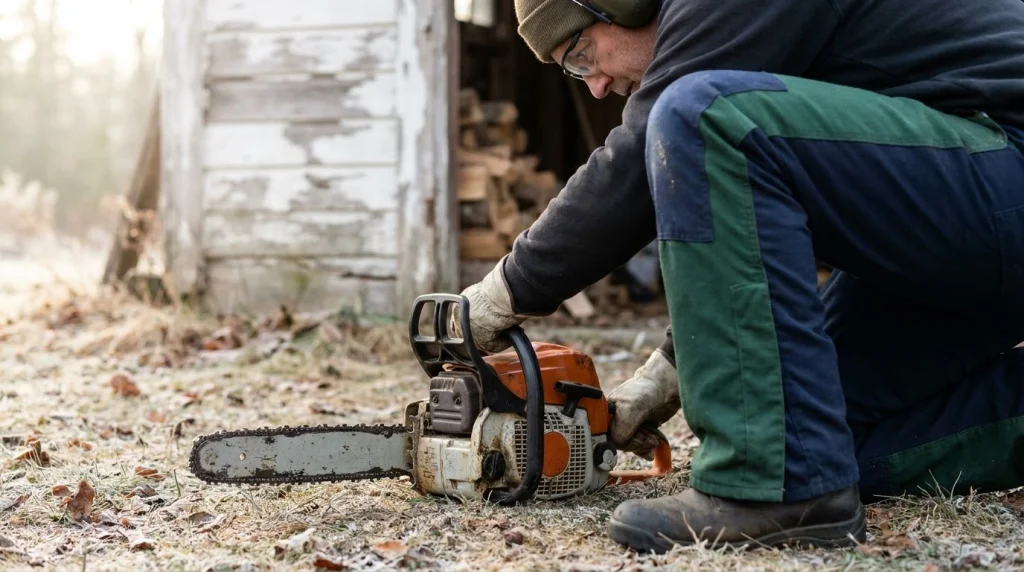
Use a chainsaw primer by preparing the saw, pressing the bulb as directed, and following the correct cold-start sequence for your model.
The following procedure applies to conventional gasoline chainsaws equipped with a manual fuel pump or purge bulb. Your operator’s manual takes priority if its instructions differ.
Step 1
Prepare the chainsaw
Check the fuel and chain oil levels. Remove the bar cover, engage the chain brake, and put on suitable protective equipment.
Step 2
Locate the primer bulb
Identify the manual fuel pump and inspect it for visible damage or fuel leakage.
Step 3
Prime the fuel system
Press and release the bulb according to the manufacturer’s instructions. Watch for visible fuel movement if the bulb is translucent.
Step 4
Select the cold-start setting
Set the ignition and choke controls to the required starting positions. Follow your manual if the choke must be set before priming.
Step 5
Pull the starter cord
Secure the chainsaw on firm, level ground with the cutting attachment clear of obstacles. Pull the starter cord until the initial firing sound.
Step 6
Adjust the choke and restart
Move the starting control to the next position specified in your manual. Pull the starter cord again until the engine runs.
Step 7
Return the engine to idle
Disengage the fast-idle setting as directed by the manufacturer. Release the chain brake only after establishing safe control of the running saw.
The official STIHL chainsaw starting guide explains the starting differences between conventional and electronically managed chainsaw models.
Warning
Drop-starting a chainsaw reduces your control and increases injury risk. Start the saw using a stable position approved by its manufacturer.
How Many Times Should You Press a Chainsaw Primer?
The correct number of primer bulb presses depends on the chainsaw model and its fuel system design. There is no universal press count for every gasoline chainsaw.
Some manufacturers specify a particular number of presses. Others instruct you to continue priming until fuel becomes visible inside the bulb.
For example, one ECHO cold-start procedure specifies eight presses or stopping when fuel appears in the purge bulb.
That instruction applies to the equipment covered by that procedure. It should not be treated as a starting requirement for every chainsaw.
Allow the bulb to return to its original shape between presses. This gives the fuel pump time to draw fuel through its circuit.
If repeated presses produce no fuel movement, investigate the fuel supply rather than continuing to prime indefinitely.
Chainsaw Primer Bulb vs. Choke
The primer bulb prepares the fuel system, while the choke changes the mixture available to the engine during starting.
These controls perform different functions, even though both can help a cold gasoline engine start.
The following table compares the purpose and operation of a primer bulb and a conventional choke.
| Feature | Primer Bulb | Choke |
|---|---|---|
| Main purpose | Prepare fuel delivery | Enrich the starting mixture |
| Operation | Press and release | Adjust starting control |
| Cold starting | Use as specified | Use cold-start setting |
| After engine fires | Usually no further priming | Adjust as instructed |
| Warm starting | Model-dependent | Full choke usually unnecessary |
Using the primer correctly does not eliminate the need to follow the appropriate choke settings for your chainsaw.
Can You Overprime a Cold Chainsaw?
Whether excessive priming can flood a chainsaw depends on the design of its manual fuel pump.
A conventional purge bulb circulates fuel through the carburetor and sends excess fuel back to the tank. A true primer may deliver fuel differently.
Because these systems operate differently, pressing a purge bulb repeatedly is not necessarily the same as adding excessive fuel directly to the engine.
Continuing to pull the starter cord with full choke after the engine has fired can contribute to flooding. Follow the specified choke transition instead of repeatedly restarting the entire procedure.
Signs of a Flooded Chainsaw Engine
A flooded chainsaw may fail to start because excessive fuel prevents normal ignition.
Possible signs include a strong fuel odor, repeated unsuccessful starting attempts, or a fuel-wet spark plug.
These symptoms do not confirm flooding by themselves. A damaged ignition component can also prevent the fuel mixture from igniting.
Stop repeated starting attempts and consult your operator’s manual for its flooded-engine recovery procedure.
Why Is the Chainsaw Primer Bulb Not Filling?
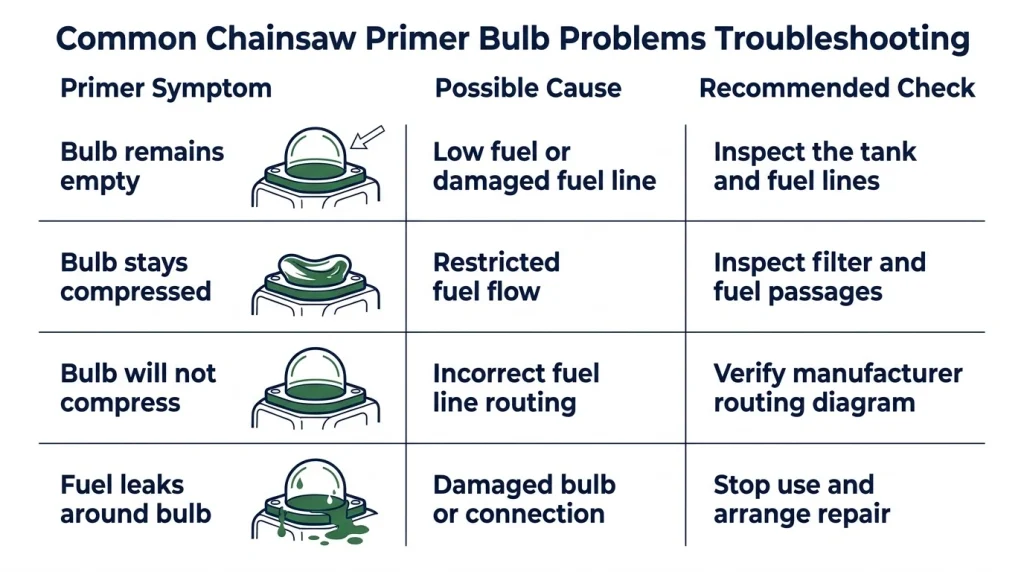
A chainsaw primer bulb may fail to fill because of insufficient fuel, a damaged fuel line, a blockage, or incorrect fuel line connections.
According to Husqvarna primer bulb troubleshooting, the behavior of the bulb can help identify where a fuel delivery problem exists.
Inspect the following symptoms before attempting another cold start.
| Primer Symptom | Possible Cause | Recommended Check |
|---|---|---|
| Bulb remains empty | Low fuel or damaged fuel line | Inspect the tank and fuel lines |
| Bulb stays compressed | Restricted fuel flow | Inspect filter and fuel passages |
| Bulb will not compress | Incorrect fuel line routing | Verify manufacturer routing diagram |
| Fuel leaks around bulb | Damaged bulb or connection | Stop use and arrange repair |
A primer bulb that consistently fails to circulate fuel requires inspection before further starting attempts.
Why Won’t a Chainsaw Start After Priming?
A chainsaw that refuses to start after priming may have a fuel quality, ignition, choke, or mechanical problem unrelated to the primer itself.
Visible fuel inside the bulb indicates that fuel has reached part of the fuel system. It does not prove that the engine receives the correct mixture or produces a spark.
Incorrect Choke Position
An incorrect choke position can prevent a cold chainsaw from starting or cause an engine that briefly fires to stop.
Check whether your chainsaw requires full choke, a separate starting position, or an electronically managed starting mode.
Fuel Delivery Problems
A fuel delivery restriction can prevent the engine from receiving sufficient fuel even when the purge bulb appears to function.
Have the fuel filter, fuel lines, and carburetor inspected if the chainsaw repeatedly starts and stalls after priming.
Ignition Problems
An ignition problem can prevent a prepared fuel mixture from burning inside the engine.
If the correct starting procedure fails repeatedly, follow the manufacturer’s spark plug inspection guidance or have the ignition system tested by a qualified technician.
Should You Prime a Warm Chainsaw?
A warm chainsaw may not require the same priming and choke procedure used for a cold engine.
Follow the warm-start instructions for your specific model. Avoid selecting full choke automatically when restarting an engine that has just been running.
Some chainsaws may still require priming after running out of fuel. This requirement depends on the fuel system design and manufacturer instructions.
Choose the starting procedure based on the engine condition rather than the outdoor temperature alone.
Common Chainsaw Priming Mistakes to Avoid
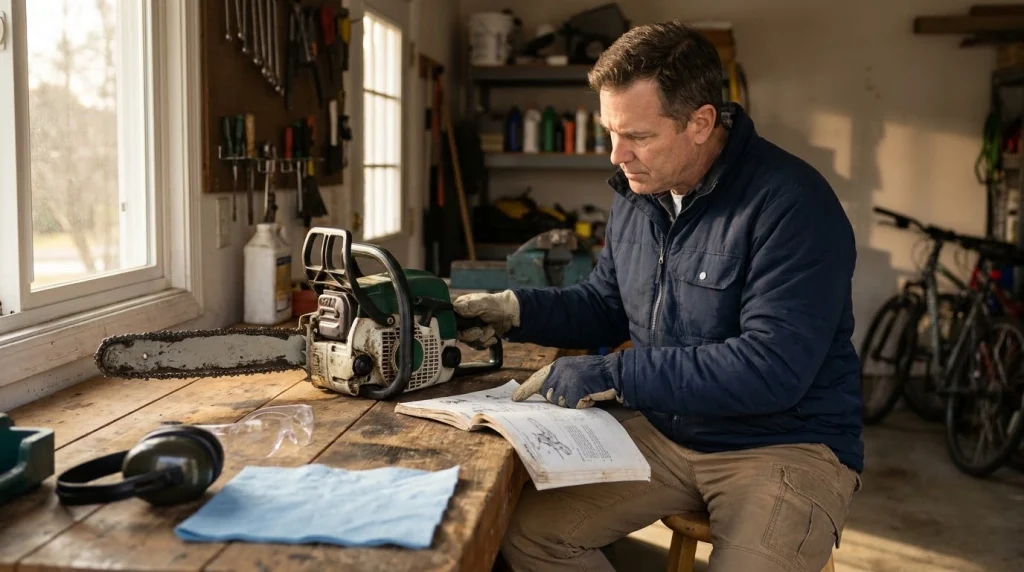
Common chainsaw priming mistakes include using an incorrect press count, ignoring fuel system damage, and applying the wrong choke setting.
Do
- Follow the model-specific starting instructions.
- Observe fuel movement during priming.
- Adjust the choke after the initial firing sound when instructed.
Avoid
- Using the same primer count for every chainsaw.
- Starting a chainsaw with a fuel leak.
- Repeatedly using full choke after the engine fires.
Correct starting technique is more useful than repeatedly pressing the primer bulb when the engine refuses to start.
When Should You Replace a Chainsaw Primer Bulb?
A chainsaw primer bulb should be replaced when inspection confirms damage or failure that prevents its proper operation.
A cracked, leaking, or permanently damaged bulb may require replacement. However, an empty or collapsed bulb can also indicate a problem elsewhere in the fuel system.
Confirm the cause before purchasing replacement parts. A new bulb will not resolve a blockage or incorrectly connected fuel line.
When buying a replacement chainsaw primer bulb, check the part number and compatibility with your particular chainsaw model.
Chainsaw Primer Bulbs
A compatible replacement primer bulb can help restore manual fuel circulation when the original bulb has failed.
Frequently Asked Questions
Can a chainsaw start without a primer bulb?
Some gasoline chainsaws are designed to start without an external primer bulb and use a different fuel preparation system. A missing bulb on such equipment is not a defect. However, a chainsaw designed with a primer should retain its original fuel system components.
Does a chainsaw primer bulb need to fill completely?
A chainsaw primer bulb does not always need to become completely full before you begin the starting procedure. Some manufacturers use visible fuel movement as the stopping point. Check the specified priming instructions rather than assuming every bulb must contain only liquid fuel.
Should I prime my chainsaw after refueling?
Priming a chainsaw after refueling may be necessary when the previous fuel supply ran out and the fuel circuit needs preparation. A routine refill does not always require repeating the entire cold-start process. Use the starting method appropriate for your engine condition.
Can I use starting fluid instead of priming?
Starting fluid should not replace the normal priming procedure unless your chainsaw manufacturer specifically authorizes its use for that model. A gasoline chainsaw has its own fuel preparation requirements. Consult the operator’s manual instead of introducing an unapproved substance into the engine.
Do electric chainsaws have primer bulbs?
Battery-powered and corded electric chainsaws do not require gasoline primer bulbs because their motors operate using electrical power rather than fuel combustion. Their starting procedures involve electrical controls instead of carburetors and chokes. Follow the manufacturer’s instructions for switches, safety locks, and power connections.
Should I hold the primer bulb down continuously?
A conventional chainsaw purge bulb works through repeated compression and release rather than being held down throughout the starting process. Releasing the bulb allows it to recover its shape and draw fuel through the system. Follow your model’s specified pumping instructions before starting.
Conclusion
Knowing how to use a chainsaw primer for cold starting helps you prepare the fuel system and follow the correct starting sequence. Use the manufacturer’s specified primer and choke settings. If fuel does not circulate normally, inspect the fuel system before attempting another start.

I write about chainsaw maintenance, troubleshooting, replacement parts, safety, and buying guides. My goal is to make chainsaw information simple, practical, and helpful for homeowners and professionals.