
How to Start a Chainsaw Correctly: Step-by-Step Guide
Quick Answer
To start a chainsaw correctly, engage the chain brake, check the fuel and chain oil, and place the saw on stable ground. Select the appropriate cold or warm starting position. Pull the starter cord until the engine starts, return the engine to normal idle, and release the brake when ready to cut.
- Inspect the chainsaw and engage the chain brake.
- Select the correct choke and starting controls.
- Secure the chainsaw on flat ground.
- Pull the starter cord using controlled movements.
- Allow the engine to settle into normal idle.
Learning how to start a chainsaw correctly can help you avoid flooded engines, unnecessary starter cord wear, and unsafe chain movement. Whether you own a gas-powered, battery-powered, or corded chainsaw, the correct starting method depends on its power source and controls.
This guide explains cold starts, warm starts, electric starting procedures, common mistakes, and the checks you should complete before cutting.
What Should You Check Before Starting a Chainsaw?

Before starting a chainsaw, inspect its fuel supply, lubrication system, cutting chain, handles, and safety controls. These checks help identify problems before the engine or motor starts.
Always inspect a chainsaw with the engine switched off. Disconnect the power supply or remove the battery from electric models before inspecting or adjusting the cutting attachment.
- Fuel: Check that a gasoline chainsaw contains the fuel mixture specified by its manufacturer.
- Chain oil: Fill the lubrication reservoir with suitable bar and chain oil.
- Chain tension: Adjust the cutting chain according to the owner’s manual.
- Chain brake: Confirm that the brake and front hand guard operate correctly.
- Handles: Check that both handles are secure, clean, and dry.
- Guide bar: Inspect the cutting attachment for visible damage.
- Starting controls: Identify the stop switch, choke, and throttle lockout.
Wear suitable chainsaw protective equipment, including eye protection, hearing protection, gloves, protective legwear, and sturdy safety footwear.
The OSHA chainsaw safety guidelines recommend inspecting operating controls and starting the saw at least 10 feet away from its fueling location.
Understand Your Chainsaw Starting Controls
Chainsaw starting controls regulate ignition, fuel delivery, airflow, and engine speed. Understanding their functions helps you select the correct starting procedure without repeatedly pulling the starter cord.
The following table explains the main controls found on conventional gasoline chainsaws.
| Starting Control | Function | When Used |
|---|---|---|
| Chain brake | Restricts chain movement | Before starting |
| Choke | Enriches the starting fuel mixture | Cold engine starts |
| Purge bulb | Circulates fuel through the fuel system | When specified in the manual |
| Stop switch | Controls engine ignition | Starting and stopping |
| Decompression valve | Reduces starting resistance | Before pulling the starter, if equipped |
| Throttle trigger | Controls engine speed | After ignition and during operation |
Not every chainsaw has these controls. Electronic fuel management systems may use a different starting sequence from conventional carburetor-equipped engines.
How to Start a Gas Chainsaw Correctly
Starting a conventional gas chainsaw involves securing the machine, selecting the correct engine settings, pulling the starter cord, and returning the engine to normal idle.
The following procedure applies to many gasoline chainsaws with manual choke controls. Follow your model’s operating instructions whenever its controls differ.
Step 1
Engage the Chain Brake
Move the front hand guard into its braking position. Remove the guide bar cover and keep the cutting attachment clear of obstacles.
Step 2
Set the Starting Controls
Select the ignition and choke settings recommended for the engine temperature. Operate the purge bulb and decompression valve if your model requires them.
Step 3
Secure the Chainsaw on the Ground
Place the saw on level ground with the chain clear of nearby objects. Secure the rear handle with your right foot and grip the front handle with your left hand.
Step 4
Pull the Starter Cord
Take up the slack gently before pulling with a controlled motion. Guide the starter handle back instead of allowing the cord to snap into its housing.
Step 5
Adjust the Choke After Ignition
When the engine briefly fires during a cold start, select the next starting position specified in the manual. Continue pulling until the engine runs.
Step 6
Return the Engine to Normal Idle
Disengage the fast-idle setting using the manufacturer’s prescribed procedure. Confirm that the engine runs steadily without holding the throttle open.
Step 7
Complete the Safety Checks
Check chain braking and lubrication according to the operating manual. Release the brake only when required for these checks or when you are ready to cut.
These starting principles are consistent with the STIHL chainsaw starting instructions, which distinguish between conventional and electronically managed starting systems.
How to Start a Cold Chainsaw
A cold gasoline chainsaw usually requires a richer fuel mixture during startup. Conventional engines achieve this by using a choke that reduces incoming air.
Use the cold-start procedure when the engine has cooled completely or has not been operated for an extended period.
- Engage the chain brake and secure the chainsaw.
- Set the ignition control to its operating position.
- Operate the purge bulb if required.
- Select the cold-start choke position.
- Pull the starter until the engine briefly fires.
- Move the choke to the next specified starting position.
- Restart the engine and return it to normal idle.
Some chainsaws briefly fire and stop while the full choke is engaged. This response can indicate that the engine is ready for the next starting stage.
Continuing to pull with full choke after the initial firing sound can introduce excess fuel into the engine. Follow the prescribed transition to prevent flooding.
Warning
Gasoline engines produce dangerous exhaust gases. Never start or run a gas chainsaw inside a garage, shed, or other enclosed space.
How to Restart a Warm or Hot Chainsaw
A warm chainsaw generally needs less fuel enrichment than a cold engine. Many conventional models restart without full choke when the engine retains operating heat.
A warm start is common after stopping briefly to reposition wood, inspect the work area, or take a break.
- Engage the chain brake.
- Check that the ignition switch is enabled.
- Select the manufacturer’s warm-start position.
- Secure the chainsaw on stable ground.
- Pull the starter cord with controlled movements.
- Return the engine to normal idle after starting.
Some models require a fast-idle setting for a warm restart. Others use the regular operating position.
The Husqvarna Chainsaw Academy explains that warm engines generally restart without choke, although certain models may require a different throttle setting.
Cold Start vs. Warm Start: What Is the Difference?
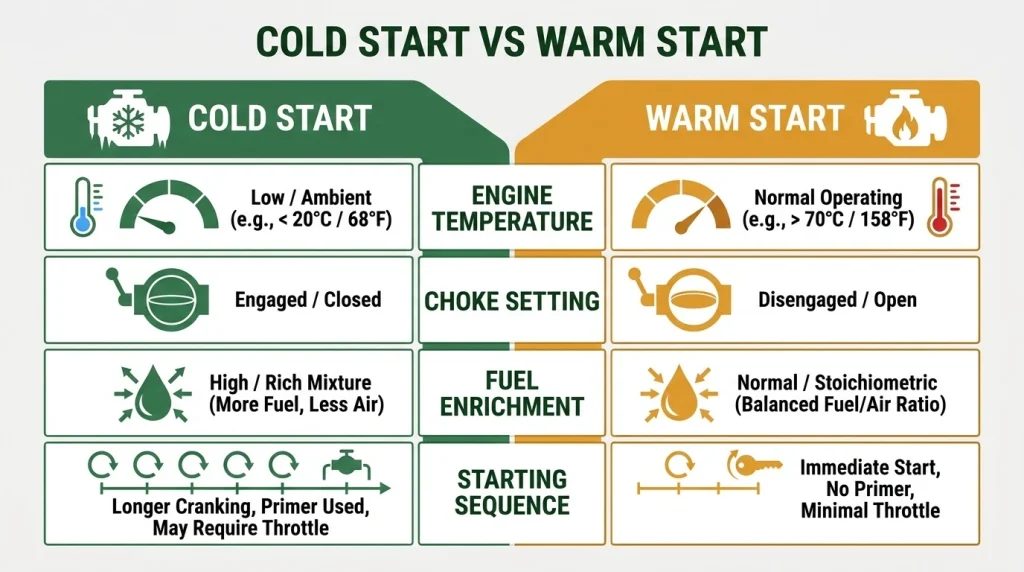
The main difference between cold and warm chainsaw starting is the amount of fuel enrichment the engine requires. Engine temperature determines the appropriate starting position.
| Starting Factor | Cold Start | Warm Start |
|---|---|---|
| Engine temperature | Engine has cooled | Engine retains heat |
| Choke setting | Cold-start position | Usually no full choke |
| Fuel enrichment | Greater enrichment | Less enrichment |
| Starting sequence | May require a choke transition | Usually fewer control changes |
Select the starting method according to engine temperature and manufacturer instructions rather than outdoor temperature alone.
How to Start an Electric or Battery-Powered Chainsaw
Electric chainsaws use a powered motor instead of a gasoline engine. They do not require carburetor enrichment, fuel priming, or a recoil starter.
Battery-powered and corded chainsaws have different power connections, but both commonly use a trigger lockout to prevent accidental activation.
Starting a Battery-Powered Chainsaw
A battery-powered chainsaw starts through its electrical controls after a compatible battery is securely installed.
- Inspect the saw with its battery removed.
- Check chain tension and bar oil.
- Engage the chain brake if equipped.
- Install the correct charged battery.
- Enable the power control if required.
- Hold both handles securely with the chain clear of objects.
- Follow the manual’s brake release and trigger activation sequence.
Some battery chainsaws prevent motor activation while the chain brake is engaged. Never bypass this safety feature.
Starting a Corded Electric Chainsaw
A corded chainsaw requires a suitable electrical connection and the correct activation sequence for its safety controls.
Inspect the power cord before connecting the saw. Keep the cable away from the cutting attachment and follow the manufacturer’s electrical safety requirements.
Hold the chainsaw with both hands before activating the motor. Release the trigger to stop the motor and wait for the cutting chain to stop completely.
What Is the Safest Position for Starting a Chainsaw?
The ground-start position provides a stable starting platform for conventional rear-handle gasoline chainsaws. It helps prevent uncontrolled movement while you operate the recoil starter.
Choose a firm, level surface that is free from loose debris. Keep the guide bar away from the ground and surrounding objects.
Some manufacturers also permit a supported starting position with the rear handle secured between the legs. Beginners should learn the ground-start technique before considering other approved methods.
Do
- Use a stable starting surface.
- Maintain a firm grip on the saw.
- Keep other people away from the cutting attachment.
Avoid
- Drop-starting the chainsaw.
- Starting with the guide bar touching wood.
- Using an unstable or slippery surface.
Never suspend a chainsaw in the air while pulling the starter cord. This technique reduces your ability to control the machine during ignition.
Common Chainsaw Starting Mistakes
Common chainsaw starting mistakes include incorrect choke settings, disabled ignition controls, poor stabilization, and excessive pulling of the starter cord.
Recognizing these mistakes helps you distinguish an incorrect starting procedure from a mechanical problem.
- Using full choke when the engine is already warm.
- Leaving the ignition switch in its stop position.
- Continuing to pull after the engine fires on full choke.
- Allowing the starter cord to retract without control.
- Holding the throttle open against the engaged chain brake.
- Attempting to start a chainsaw with damaged safety controls.
A chainsaw that does not respond to its correct starting procedure may require further inspection. Repeatedly pulling the starter does not correct an underlying mechanical fault.
What Should You Do If Your Chainsaw Will Not Start?
If your chainsaw will not start, stop repeated starting attempts and check the basic operating conditions before investigating mechanical faults.
Confirm that you selected the correct starting procedure for the engine temperature. Check the ignition setting and available fuel or battery power.
On gasoline models, a strong fuel smell after repeated starting attempts may indicate engine flooding. Switch off the saw and consult its model-specific flooded-engine instructions.
Do not attempt to force a starter cord that feels locked or unusually resistant. Mechanical inspection may be necessary before the engine can be started safely.
Arrange professional service if the chainsaw has a fuel leak, damaged starting mechanism, faulty brake, or persistent starting problems.
What Should You Check After the Chainsaw Starts?

After starting a chainsaw, verify normal idle behavior, chain lubrication, and functioning safety controls before making your first cut.
The engine should run consistently after leaving its starting mode. Follow the owner’s manual for any required warm-up procedure.
- Confirm that the engine returns to normal idle.
- Check for abnormal engine sounds or excessive vibration.
- Perform the manufacturer’s chain brake test.
- Confirm that the bar and chain receive lubricant.
- Check that the chain remains stationary at normal idle with the brake released on a gasoline model.
Stop the engine if the chain continues moving at normal idle. A chainsaw with defective idle behavior or safety controls should not be used until repaired.
Frequently Asked Questions
Should a chainsaw be started with the brake engaged?
A gasoline chainsaw should normally be started with its chain brake engaged to prevent unintended chain movement during ignition. Some engines temporarily operate at elevated speed during startup. Follow your model’s instructions when transitioning from its starting mode to normal operation.
Can you start a chainsaw without a primer bulb?
A chainsaw designed without a primer or purge bulb can start normally using its manufacturer-approved fuel delivery and starting system. Not every gasoline chainsaw requires manual fuel circulation. However, a missing or damaged bulb on a model designed to use one requires inspection before operation.
Should you start a chainsaw with the bar cover on?
The protective guide bar cover should be removed before starting a chainsaw and completing its operational safety checks. The cover protects the cutting attachment during storage and transport. Keep the exposed bar and chain clear of surrounding objects throughout the starting procedure.
Why does a chainsaw briefly start and then stop?
A conventional gasoline chainsaw may briefly fire and stop because its full-choke setting is intended for initial cold ignition. This behavior can be normal during startup. Persistent stalling after selecting the correct running position indicates that further inspection may be needed.
Should you pull a chainsaw starter cord all the way?
A chainsaw starter cord should be pulled smoothly without forcing it against the end of its available travel. Follow the starter technique specified in your operating manual. Maintain control of the handle during retraction to protect the recoil starter mechanism from unnecessary impact.
Can you start a chainsaw immediately after refueling?
A gasoline chainsaw can be restarted after refueling once its fuel cap is secure and the required safety precautions are complete. Move away from the fueling location before starting. If fuel has spilled onto the machine, follow the manufacturer’s cleaning and safety instructions first.
Conclusion
Knowing how to start a chainsaw correctly begins with secure positioning, proper safety checks, and selecting the appropriate starting controls. Use the cold-start or warm-start procedure that matches your engine condition, and consult your model’s manual before operating any unfamiliar chainsaw.
I write about chainsaw maintenance, troubleshooting, replacement parts, safety, and buying guides. My goal is to make chainsaw information simple, practical, and helpful for homeowners and professionals.