Cold Chainsaw Start Choke Position: How to Use It
Quick Answer
Use the full choke position for a cold chainsaw start on most conventional gas-powered chainsaws. Pull the starter cord until the engine briefly fires. Then move the control to the half-throttle or run position, depending on your model. Leaving the choke fully closed for too long can flood the engine.
- Engage the chain brake before starting.
- Select the full choke or cold-start position.
- Listen for the first engine firing sound.
- Move the control to the next manufacturer-specified starting position.
- Return the engine to normal idle after starting.
Choosing the correct choke position for a cold chainsaw start can prevent unnecessary pulling, engine flooding, and starting problems. Whether your chainsaw has been sitting overnight or stored for an extended period, the correct starting procedure depends on its engine temperature and control system.
This guide explains how to identify the right choke setting, when to change positions, and what to do when your chainsaw refuses to start.
What Choke Position Should You Use for a Cold Chainsaw Start?
The full choke position is the correct initial setting for most cold gas-powered chainsaws equipped with a conventional manual choke. This setting temporarily restricts incoming air to create a richer fuel mixture.
A richer mixture helps a cold engine ignite. Once the engine briefly fires, it generally needs more air to continue running.
Depending on the chainsaw, the next setting may be labeled half choke, warm start, half throttle, or run. These labels are not interchangeable across every model.
Always check the starting instructions in your chainsaw’s operator manual before selecting a choke position.
Why Does a Cold Chainsaw Need Full Choke?
A cold chainsaw needs full choke because gasoline does not vaporize as readily inside a cold engine. The choke helps create a fuel-rich mixture that supports initial combustion.
The carburetor is the component responsible for mixing fuel and air before the mixture enters the engine. Closing the choke changes the amount of air entering this system.
The richer mixture helps the spark plug ignite the fuel during startup. However, the engine needs a more balanced mixture once combustion begins.
The main functions of the choke include:
- Restricting incoming air during a cold start.
- Increasing the proportion of fuel in the mixture.
- Helping the engine achieve initial ignition.
- Supporting startup before normal operating conditions are established.
The choke is a temporary starting aid rather than a normal engine operating setting.
Full Choke vs Half Choke vs Run Position
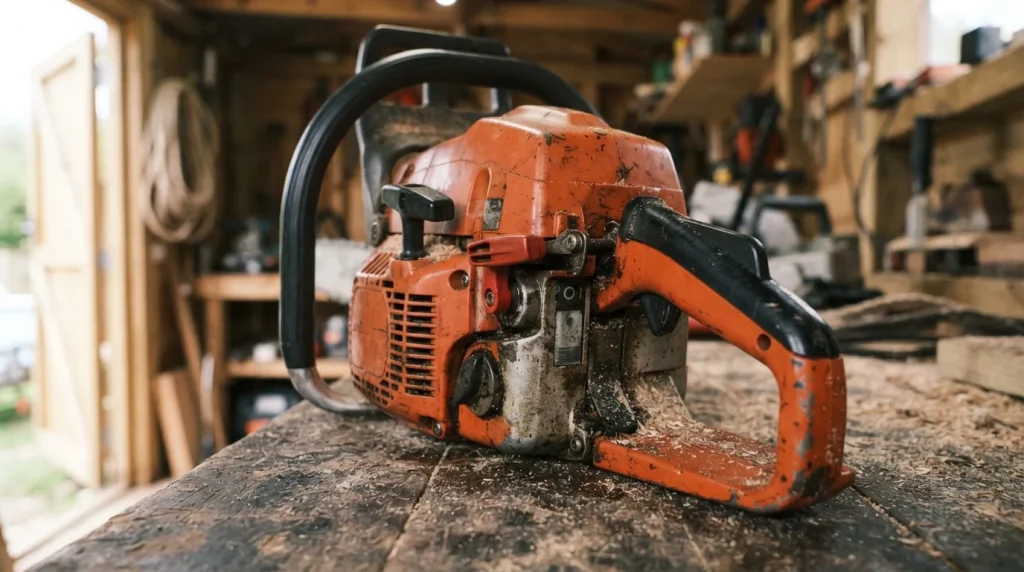
Full choke supports initial cold ignition, while an intermediate starting position helps the engine continue running. The run position allows normal engine operation without unnecessary choke restriction.
The following table compares common chainsaw starting control positions.
| Choke Position | When to Use | Purpose |
|---|---|---|
| Full choke | Cold engine startup | Creates a richer starting mixture |
| Half choke | Intermediate startup on applicable models | Reduces air restriction |
| Half throttle | After initial firing on applicable models | Supports starting without full choke |
| Run | Normal operation or specified restart procedure | Allows normal airflow |
The main difference is that half throttle describes a throttle setting, while half choke describes partial air restriction. Your chainsaw may combine these functions through a single control.
How to Set the Choke for a Cold Chainsaw Start
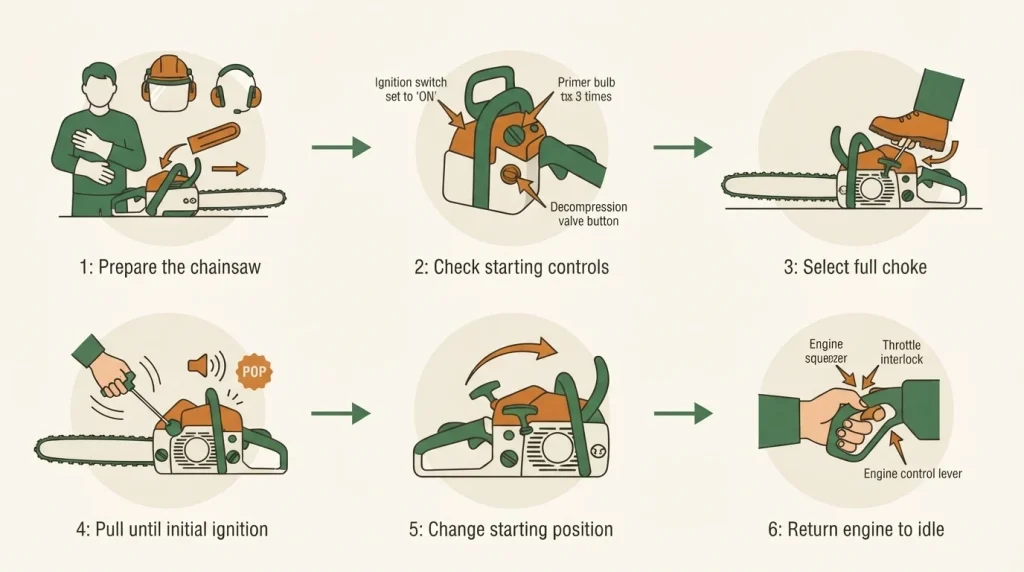
Start a conventional cold chainsaw by selecting full choke and moving to the next specified setting after initial ignition. Complete the starting procedure on stable ground while following your operator manual.
The following sequence applies to many conventional manual-choke chainsaws. Models with automatic starting controls may require a different procedure.
Step 1
Prepare the chainsaw
Put on the required protective equipment. Remove the guide bar cover and engage the chain brake.
Step 2
Check the starting controls
Ensure the ignition control permits starting. Use the primer bulb and decompression valve if your model requires them.
Step 3
Select full choke
Move the choke lever to its designated cold-start setting. Secure the chainsaw on level ground with the cutting attachment clear of surrounding objects.
Step 4
Pull until initial ignition
Hold the chainsaw securely and operate the starter cord according to the manual. Listen for the engine’s brief firing sound.
Step 5
Change the starting position
Move the control out of full choke to the specified intermediate or run setting. Operate the starter again as directed.
Step 6
Return the engine to idle
Disengage the starting throttle as instructed by the manufacturer. Complete the required safety inspections before beginning work.
The Husqvarna Chainsaw Academy explains safe starting positions and the differences between cold and hot engine startup.
Warning
An engaged starting throttle can cause chain movement. Never drop-start a chainsaw, and always engage the chain brake before operating the starter cord.
When Should You Move a Chainsaw Out of Full Choke?
Move the chainsaw out of full choke when the engine briefly fires, unless your operator manual specifies another procedure.
The first firing sound may resemble a short cough, sputter, or pop. The engine may stop immediately afterward without continuing to run.
On conventional chainsaws, this response can be a normal part of cold starting. The engine has achieved initial combustion and needs the next starting setting.
Continuing to pull with full choke engaged after this signal can introduce excess fuel. This makes the engine harder to start instead of improving ignition.
How Many Starter Pulls Should You Make With Full Choke?
There is no universal number of starter pulls that works for every chainsaw. Use your model’s specified pull limit and listen for the first ignition signal.
The required starting effort depends on engine temperature, fuel delivery, engine condition, and the design of the starting system.
A chainsaw that does not respond within its recommended starting sequence should be inspected rather than repeatedly pulled with full choke engaged.
Check whether you selected the correct control position and completed the required priming procedure.
Can You Start a Cold Chainsaw With Half Choke?
Some chainsaws can start with an intermediate choke setting, but half choke is not the standard initial position for every cold engine.
Starting with insufficient fuel enrichment may make ignition difficult. This is especially relevant when the engine is fully cooled.
Certain models have specific starting instructions for different temperatures. Others use a combined starting control rather than separate full and half choke positions.
Follow the manufacturer’s procedure instead of assuming every chainsaw responds to the same settings.
What Happens If You Leave the Choke On Too Long?
Leaving the choke on too long can create an excessively rich fuel mixture and flood a chainsaw engine. Engine flooding occurs when excess fuel interferes with normal ignition.
Flooding can develop when you repeatedly operate the starter after the engine has already attempted to fire.
Possible signs of an excessively rich starting mixture include:
- Repeated starting attempts without sustained ignition.
- A noticeable gasoline smell.
- An engine that briefly fires and repeatedly stops.
- A spark plug that becomes wet with fuel.
These symptoms are not exclusive to flooding. Fuel delivery problems and ignition faults can produce similar starting difficulties.
If flooding is suspected, stop repeated starting attempts and follow the flooded-engine recovery procedure in your operator manual.
How to Choose the Choke Position Based on Engine Temperature
Choose the choke position according to the engine’s temperature rather than outdoor temperature alone. A recently operated engine may remain warm even in cold weather.
If you
Are starting a fully cooled conventional chainsaw.
Choose full choke when specified, because a cold engine benefits from fuel enrichment.
If you
Hear the engine briefly fire during a cold start.
Choose the next specified starting position, because continued full choke may cause flooding.
If you
Are restarting an engine that remains warm.
Choose the warm-start procedure, because additional full-choke enrichment may be unnecessary.
Manufacturer instructions take priority when your chainsaw has an unusual control arrangement or a dedicated starting system.
Do All Gas Chainsaws Have the Same Choke Positions?
Gas chainsaws use different choke controls depending on their engine design and starting system. Some have separate choke levers, while others combine several starting functions.
Manual choke chainsaws
Manual choke chainsaws require you to select the appropriate choke setting during startup. The operator controls when the choke opens or closes.
These models commonly require a change in starting position after initial engine firing.
Combined control lever chainsaws
Combined control lever chainsaws integrate starting and operating functions into a single lever. Moving the control may change both the choke and starting throttle settings.
The markings and order of these settings depend on the specific model.
Electronically managed chainsaws
Electronically managed chainsaws may use a dedicated starting position instead of a conventional manual choke sequence.
For example, STIHL provides different procedures for conventional and M-Tronic chainsaws in its official chainsaw starting guide.
Identify your chainsaw’s starting system before applying instructions intended for another model.
Why Won’t My Chainsaw Start With Full Choke?
A chainsaw may fail to start with full choke because of flooding, incorrect control settings, fuel delivery problems, or ignition faults.
Full choke helps create the starting mixture. However, it cannot repair an underlying mechanical or fuel system problem.
Incorrect starting procedure
An incorrect starting sequence can prevent a mechanically sound chainsaw from starting. Check whether the ignition, choke, primer bulb, and starting throttle are set correctly.
Make sure you are using instructions intended for your exact chainsaw model.
Flooded engine
A flooded chainsaw may refuse to start because excess gasoline prevents reliable ignition. Repeated full-choke attempts can contribute to this problem.
Use the manufacturer’s flooding recovery procedure before attempting another start.
Fuel delivery problems
Fuel delivery problems can prevent gasoline from reaching the engine during startup. Check the fuel supply and inspect accessible fuel system components as instructed by the manual.
Do not operate the chainsaw if you discover a fuel leak.
Ignition problems
Ignition problems can prevent combustion even when the choke and fuel mixture are correct. A faulty or fouled spark plug is one possible cause.
Arrange qualified servicing if the required inspection involves procedures beyond your experience.
The manufacturer’s starting troubleshooting guide identifies choke settings, priming, fuel supply, and ignition as areas to investigate during cold-start difficulties.
Why Does My Chainsaw Only Run With the Choke On?
A chainsaw that only runs with the choke on may have an underlying fuel or air mixture problem. Continuous choke operation is not a normal solution.
Closing the choke can temporarily compensate for an insufficient fuel supply or an overly lean mixture. A lean mixture contains too much air relative to fuel.
Possible areas requiring inspection include:
- Fuel filter restrictions.
- Carburetor fuel delivery problems.
- Damaged fuel lines.
- Unintended air entering the engine.
These are possible causes rather than a confirmed diagnosis. Stop using the chainsaw and have the fuel system inspected if the engine cannot operate normally without choke.
Common Cold-Start Choke Mistakes to Avoid
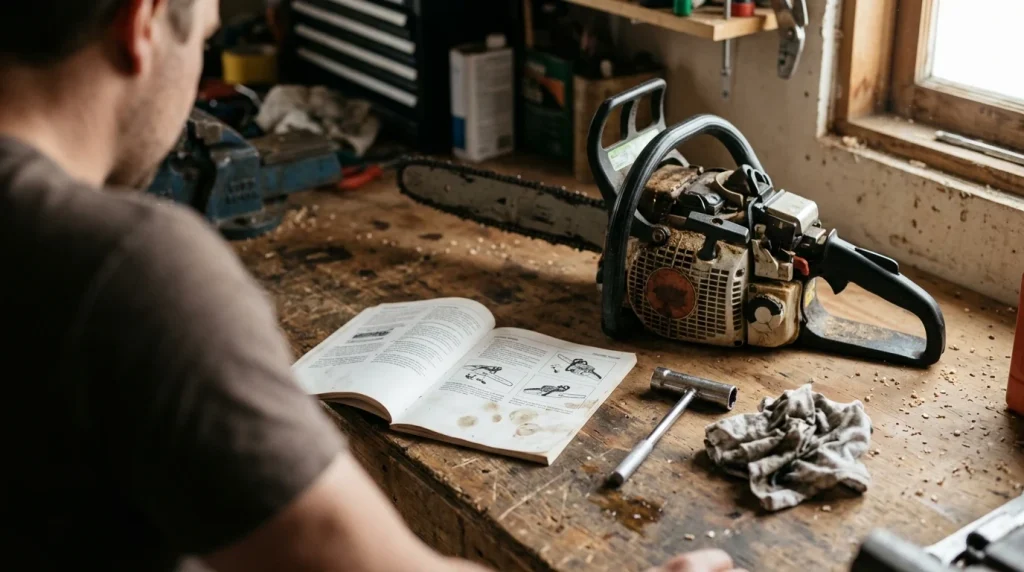
The most common choke mistakes involve using the wrong starting position, overlooking the first ignition signal, and continuing to use full choke unnecessarily.
Do
- Check the starting control markings.
- Follow the model-specific cold-start sequence.
- Pay attention to the first ignition sound.
Avoid
- Using full choke for every warm restart.
- Ignoring the manufacturer’s starting attempt limit.
- Operating the chainsaw continuously with the choke closed.
Consistent starting habits help distinguish incorrect choke operation from a genuine engine fault.
Frequently Asked Questions
Is the choke open or closed during cold starting?
A conventional manual choke is closed or substantially closed during the initial cold-start stage to enrich the fuel mixture. The control is subsequently moved toward its normal operating setting. Check the control markings because lever movement and choke valve movement may differ between models.
Does a primer bulb replace the choke?
A primer or purge bulb does not automatically replace the choke because these components perform different functions during engine startup. The bulb helps prepare fuel delivery, while the choke changes the starting mixture. Some chainsaws require both controls as part of their cold-start procedure.
Do battery-powered chainsaws have a choke?
Battery-powered chainsaws do not require a choke because their electric motors do not use gasoline or a carburetor. Instead, they use electrical starting controls and safety interlocks. Cold weather may affect battery performance, but it does not create a need for fuel enrichment.
What does the choke symbol on a chainsaw mean?
The choke symbol identifies a starting control position associated with fuel enrichment or the manufacturer’s designated engine starting mode. The exact symbol varies between chainsaw designs. Consult the control diagram in your operator manual rather than assuming that identical lever directions apply across different models.
Can a cold chainsaw start without using choke?
A cold chainsaw may start without manual choke if its engine design or automatic starting system provides the required fuel mixture. Conventional engines may be more difficult to start without enrichment. Follow the designated procedure rather than treating a successful no-choke start as a universal rule.
Does a decompression valve affect the choke setting?
A decompression valve helps reduce the effort required to operate the starter without replacing the choke’s fuel enrichment function. Chainsaws equipped with both components may require their separate use during startup. Follow the manufacturer’s instructions regarding when to activate the valve and select the starting control.
Conclusion
The correct choke position for a cold chainsaw start is usually full choke on conventional gas-powered models. Change to the specified starting position after initial ignition, and avoid unnecessary full-choke pulling. If starting problems continue, check your operator manual and investigate possible fuel or ignition faults.
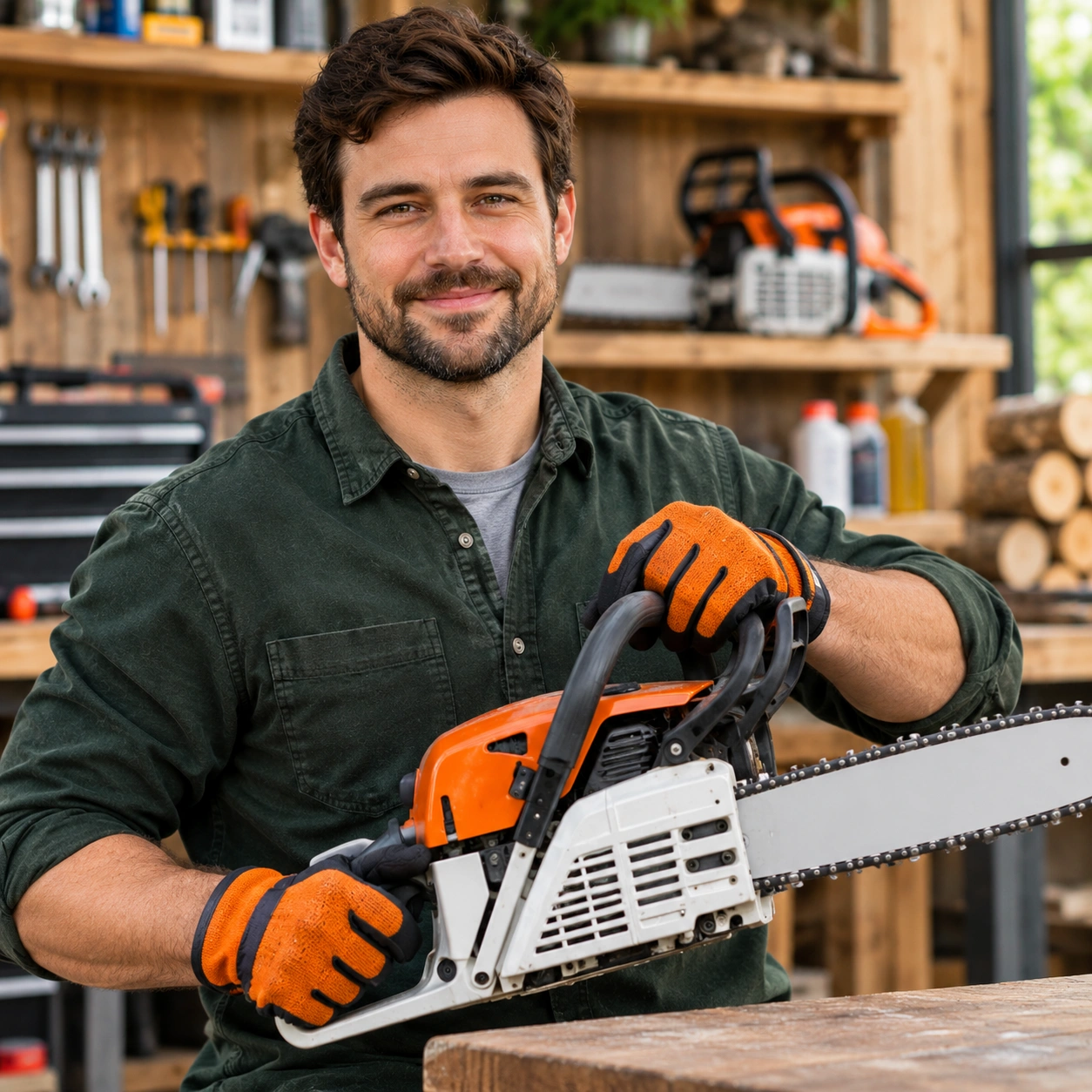
I write about chainsaw maintenance, troubleshooting, replacement parts, safety, and buying guides. My goal is to make chainsaw information simple, practical, and helpful for homeowners and professionals.