
Chainsaw Won’t Start After Sitting Overnight? Fixes
Quick Answer
If your chainsaw won’t start after sitting overnight, check the cold-start procedure, fuel condition, ignition switch, and spark plug. An incorrect choke setting or flooded engine may prevent ignition. Restricted fuel delivery, carburetor problems, and low engine compression can also cause repeated starting difficulties after the engine cools.
- Follow the correct cold-start procedure for your chainsaw.
- Check the fuel level and fuel mixture.
- Look for signs of engine flooding.
- Inspect the spark plug and air filter.
- Investigate fuel delivery if the problem keeps returning.
Your chainsaw worked perfectly yesterday, but now it refuses to start. An overnight starting problem can interrupt your work, especially when the engine shows no obvious signs of damage.
This guide explains the possible causes, how to identify them, and which checks to perform before replacing expensive engine components. The troubleshooting steps focus on gasoline-powered chainsaws.
Why Won’t a Chainsaw Start After Sitting Overnight?
A chainsaw may refuse to start overnight because cooling changes its starting requirements or exposes an existing fuel, ignition, or engine problem.
A cold engine needs different starting conditions than a warm engine. Fuel delivery and choke operation become particularly important during the first start of the day.
The most useful areas to investigate include:
- Incorrect cold-start procedure.
- Excess fuel inside the engine.
- Old or incorrect fuel mixture.
- Dirty or damaged spark plug.
- Restricted fuel delivery.
- Carburetor malfunction.
- Insufficient engine compression.
Sitting overnight does not necessarily damage a chainsaw. Instead, the resting period may reveal a problem that was less noticeable while the engine was warm.
Incorrect Cold-Start Procedure
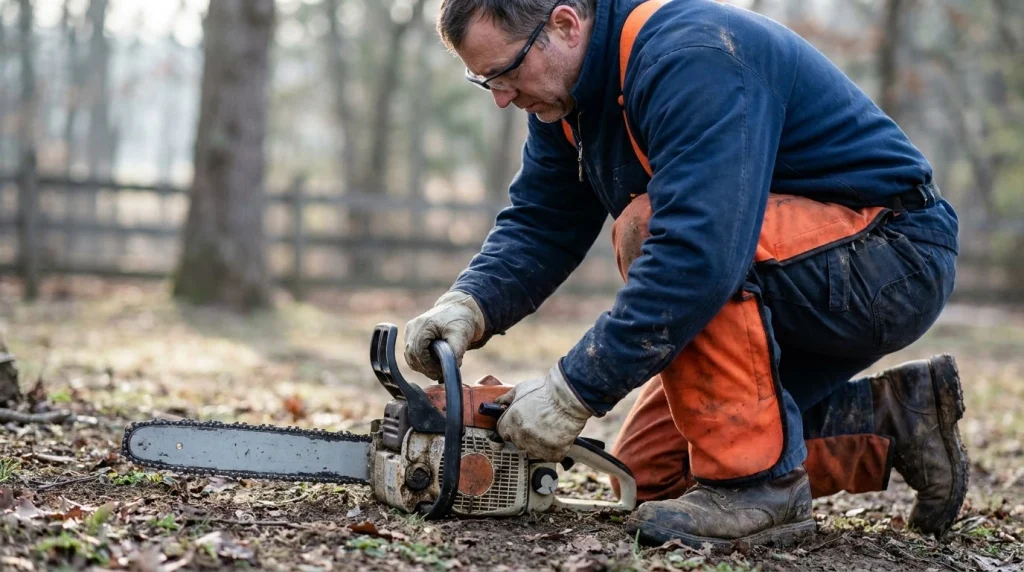
An incorrect cold-start procedure can prevent a healthy chainsaw from starting after it has cooled overnight.
The choke helps create a fuel-rich mixture for starting a cold gasoline engine. However, leaving the choke engaged for too long can interfere with ignition.
Many conventional chainsaws require a different choke position after the engine briefly fires. Some models use automatic starting systems instead of traditional choke controls.
How to Start a Cold Chainsaw Correctly
Starting a cold chainsaw correctly requires following the control sequence specified in its owner’s manual.
- Place the chainsaw on stable ground outdoors.
- Engage the chain brake and wear appropriate protective equipment.
- Set the ignition control to the required starting position.
- Operate the primer or purge bulb if your model requires it.
- Set the choke according to the manufacturer’s instructions.
- Pull the starter cord using the approved starting technique.
- Adjust the choke when instructed and complete the starting procedure.
The Husqvarna cold-start guide illustrates how starting procedures differ between cold engines, warm engines, and specific chainsaw models.
Flooded Chainsaw Engine
A flooded chainsaw engine contains excessive fuel, which prevents the air and fuel mixture from igniting properly.
Flooding can occur when you repeatedly attempt to start a chainsaw with the choke engaged. A fuel delivery fault may also contribute to recurring flooding.
Signs Your Chainsaw Engine Is Flooded
A strong gasoline smell and repeated unsuccessful starting attempts can indicate engine flooding.
- Strong fuel odor around the chainsaw.
- Wet spark plug electrodes.
- Engine briefly fires but does not continue running.
- Starting becomes harder after repeated choking.
- Engine fails to respond to additional starter pulls.
A wet spark plug does not confirm the exact cause. An ignition fault can also leave unburned fuel inside the engine.
What to Do if Your Chainsaw Is Flooded
A flooded chainsaw should be restarted using the manufacturer’s specific flooded-engine recovery procedure.
Stop repeating the full-choke starting sequence. Consult your owner’s manual before changing the throttle position or attempting to clear excess fuel.
The STIHL chainsaw troubleshooting FAQ identifies excessive starting attempts with the choke engaged as a common cause of flooding.
Warning
Gasoline vapors can ignite and cause serious burns. Never attempt to start a chainsaw near spilled fuel, open flames, or other ignition sources.
Old Fuel or Incorrect Fuel Mixture
Old fuel or an incorrect gasoline and oil mixture can make a chainsaw difficult to start after storage.
Fresh fuel does not normally become unusable during a single night. However, fuel already affected by age or contamination may contribute to starting problems.
Gasoline-powered chainsaws require fuel that meets their engine specifications. Using the wrong mixture may cause poor operation or engine damage.
How to Identify a Fuel Problem
A fuel problem becomes more likely when the chainsaw contains an unknown, contaminated, or incorrectly prepared fuel mixture.
Check the following before investigating mechanical components:
- Whether the fuel tank contains sufficient fuel.
- How long the fuel has been stored.
- Whether the gasoline meets engine requirements.
- Whether the correct engine oil was used.
- Whether the mixture contains visible contamination.
If you suspect unsuitable fuel, replace it using the handling and disposal instructions in your owner’s manual. Prepare fresh fuel according to the manufacturer’s specified mixture.
Dirty or Faulty Spark Plug
A dirty, worn, or damaged spark plug can prevent a chainsaw from igniting its fuel mixture during a cold start.
The spark plug produces the electrical spark needed for combustion. Deposits, physical damage, or an incorrect electrode gap may interfere with this process.
What Spark Plug Condition Can Tell You
The appearance of a spark plug provides useful clues about possible ignition and fuel-related problems.
The following table compares common spark plug conditions and their possible meanings.
| Spark Plug Condition | Possible Cause | Next Check |
|---|---|---|
| Wet with fuel | Flooding or failed ignition | Check starting procedure and ignition |
| Dry electrodes | Possible fuel delivery problem | Check fuel supply |
| Black deposits | Possible rich mixture or fouling | Check choke and air filter |
| Worn electrodes | Spark plug wear | Check replacement requirements |
| Cracked insulator | Physical damage | Replace with an approved plug |
Use spark plug appearance as a diagnostic clue rather than proof that a particular component has failed.
Should You Replace the Spark Plug?
Spark plug replacement is appropriate when the existing plug is damaged, excessively worn, or unsuitable for your chainsaw.
Use the replacement type and electrode gap specified by the manufacturer. Disconnect the ignition lead and follow the manual before removing or servicing the plug.
If a suitable replacement does not resolve the starting problem, investigate other ignition and fuel delivery components.
Clogged Fuel Filter or Damaged Fuel Line
A restricted fuel filter or damaged fuel line can prevent sufficient gasoline from reaching the carburetor during startup.
The fuel filter helps keep contaminants from entering the fuel system. Fuel lines transport gasoline between the tank and fuel delivery components.
Restricted delivery may cause difficult starting, brief engine operation, or repeated stalling.
Symptoms of Restricted Fuel Delivery
Restricted fuel delivery becomes more likely when the engine appears unable to receive enough fuel to start or continue running.
- Engine starts briefly and shuts off.
- Primer bulb behaves differently than expected.
- Chainsaw repeatedly stalls during operation.
- Visible fuel line damage.
- Fuel filter appears contaminated.
The manufacturer’s maintenance schedule explains when fuel filters need inspection or replacement. Suspected fuel leaks or damaged internal hoses should receive professional attention.
Carburetor Problems After Overnight Storage
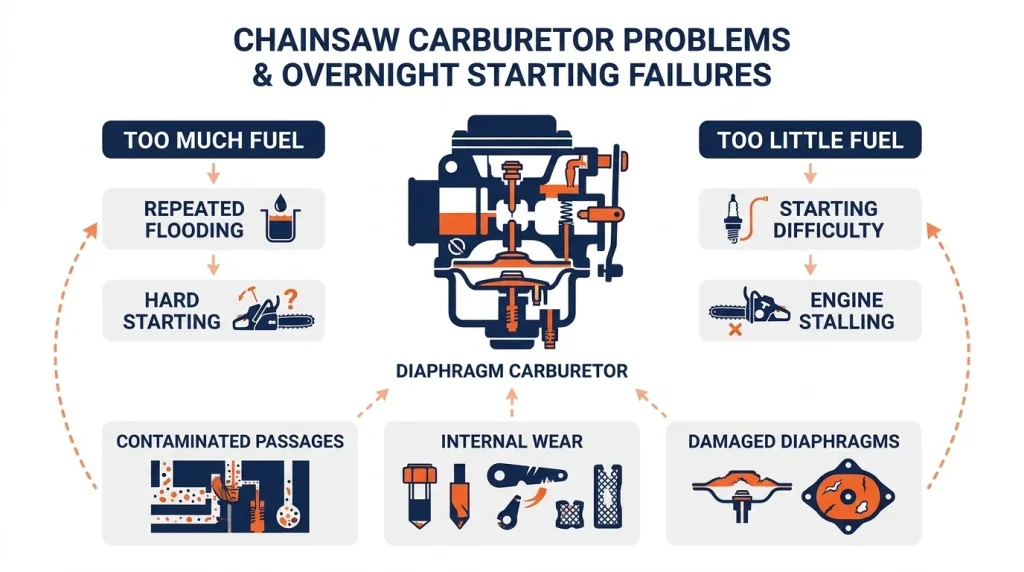
A faulty carburetor can cause overnight starting problems by delivering too much or too little fuel when the engine is cold.
The carburetor controls the mixture of air and fuel entering the engine. Conventional chainsaw carburetors contain small passages and flexible components that regulate fuel delivery.
Contamination, internal wear, or damaged diaphragms may interfere with this process.
Common Signs of Carburetor Trouble
Recurring starting difficulties despite suitable fuel and a correct starting procedure may indicate a carburetor problem.
- Repeated flooding without excessive choking.
- Engine starts but cannot maintain idle.
- Chainsaw starts warm but struggles when cold.
- Engine runs inconsistently after starting.
- Fuel delivery problems continue after routine maintenance.
These symptoms can also result from other engine faults. A carburetor inspection should follow basic fuel, air, and ignition checks rather than replace them.
Should You Adjust the Carburetor?
Carburetor adjustment should only be performed according to the specifications and procedures for your chainsaw model.
Incorrect adjustment can create an unsuitable fuel mixture and affect engine performance. Some chainsaws use electronic fuel management or restricted adjustment controls.
Professional diagnosis is preferable when the starting problem persists or requires internal carburetor work.
Dirty Air Filter or Restricted Exhaust
A dirty air filter or restricted exhaust can interfere with engine operation and make starting or maintaining idle more difficult.
The air filter removes debris from incoming air. The spark arrestor, a screen fitted within the exhaust system, helps limit the release of hot particles.
Both components require maintenance according to the chainsaw manufacturer’s instructions.
According to Husqvarna troubleshooting guidance, restricted airflow, unsuitable fuel, and exhaust blockage are possible reasons a gasoline chainsaw starts and then stalls.
How to Check for Airflow Restrictions
Airflow restrictions can be investigated by inspecting accessible filter and exhaust components when the engine is switched off and cool.
- Locate the air filter using your owner’s manual.
- Inspect the filter for dirt, damage, or heavy deposits.
- Clean or replace the filter using the approved method.
- Check whether the exhaust requires scheduled maintenance.
- Reinstall all removed covers before attempting to start.
Do not assume every air filter can be washed. Cleaning methods depend on its material and construction.
Low Engine Compression
Low engine compression can prevent a chainsaw from developing the pressure needed for reliable combustion.
Compression refers to the pressure created when the piston compresses the mixture inside the cylinder. Internal wear or damage can reduce this pressure.
Possible underlying faults include worn piston rings, cylinder damage, and sealing problems.
How to Recognize a Compression Problem
Unusually light starter cord resistance combined with persistent starting failure may justify an engine compression inspection.
Starter resistance alone cannot confirm low compression. Starting assistance mechanisms and decompression systems can also affect how the cord feels.
A compression test requires suitable equipment and model-specific interpretation. Avoid relying on a universal pressure threshold for every chainsaw.
Cold Weather and Overnight Temperature Changes
Overnight temperature changes can influence cold-start behavior by affecting fuel vaporization and the engine’s starting requirements.
A chainsaw stored in an unheated garage may require a different starting procedure from one that has been running throughout the day.
If the problem appears mainly during cold conditions, review the manufacturer’s instructions for cold-weather operation.
Some chainsaws have seasonal settings designed for particular operating conditions. These features should only be adjusted as directed in the owner’s manual.
Ignition Switch and Ignition System Problems
An incorrect ignition switch position or an ignition system fault can prevent a chainsaw from producing the spark needed to start.
The ignition system includes the spark plug, ignition module, wiring, and stop controls. A fault in any relevant component may interrupt combustion.
Begin by confirming the correct starting position of the stop switch. Inspect accessible wiring and the spark plug connection with the engine switched off.
If fuel delivery appears normal but the engine never fires, a technician can investigate the ignition system.
Diagnosing Overnight Chainsaw Starting Problems
The most effective troubleshooting approach is to identify the engine’s symptoms before replacing parts.
Use the following symptom comparison to choose the appropriate next inspection.
| Starting Symptom | Possible Cause | What to Check |
|---|---|---|
| Engine never fires | Ignition or fuel problem | Switch, fuel, and spark plug |
| Strong gasoline smell | Flooding or fuel leakage | Check for leaks before restarting |
| Starts and immediately dies | Fuel or airflow restriction | Fuel condition and filters |
| Starts warm but not cold | Cold-start or mixture problem | Choke and fuel delivery |
| Unusual starter resistance | Starter or mechanical fault | Professional mechanical inspection |
Start with accessible maintenance checks and move toward specialized testing only when the symptoms justify it.
Step-by-Step Troubleshooting Checklist
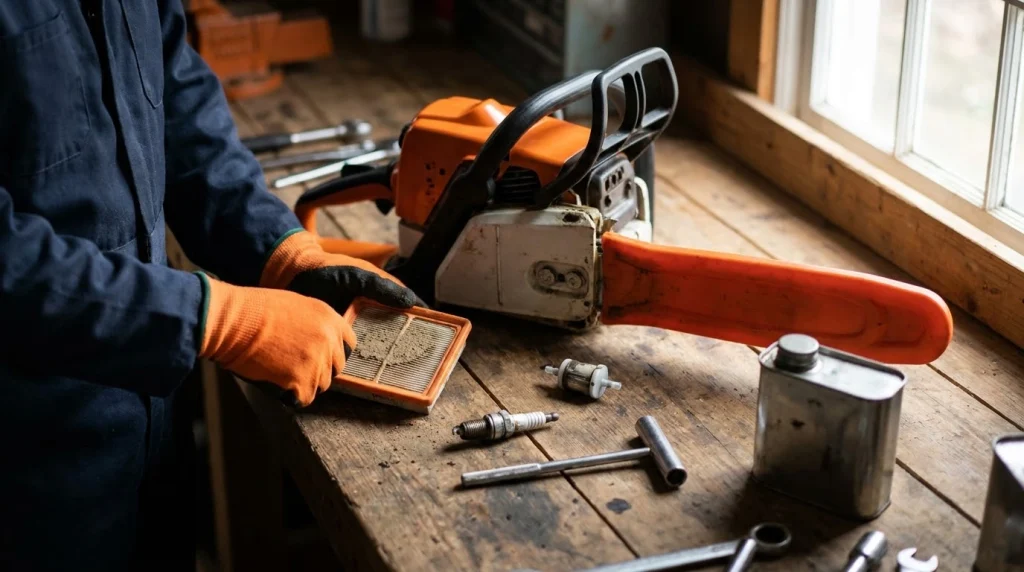
A structured troubleshooting sequence helps isolate overnight starting problems without unnecessary component replacement.
Step 1
Confirm the starting controls
Check the ignition switch and follow the cold-start sequence specified for your model.
Step 2
Inspect the fuel
Confirm sufficient fuel and verify that the mixture meets the manufacturer’s requirements.
Step 3
Investigate flooding
Stop repeated choking and follow the approved flooded-engine recovery procedure if applicable.
Step 4
Check the spark plug
Inspect the plug for deposits, wear, and damage according to the maintenance instructions.
Step 5
Inspect the filters
Check accessible air and fuel filters for contamination or overdue maintenance.
Step 6
Arrange further diagnosis
Seek professional testing of the carburetor, ignition system, and compression if basic checks do not resolve the problem.
How to Prevent Chainsaw Starting Problems Overnight
Correct storage, suitable fuel, and routine maintenance can help reduce recurring chainsaw starting difficulties.
Follow the manufacturer’s storage instructions and avoid leaving the equipment exposed to unnecessary moisture or contamination.
- Store the chainsaw in a dry, sheltered location.
- Use suitable, fresh fuel.
- Maintain the spark plug and filters.
- Inspect accessible components for damage.
- Keep the chainsaw clean between uses.
- Follow recommended long-term storage procedures.
- Investigate repeated starting problems before they worsen.
Overnight storage and long-term storage have different maintenance requirements. Follow the instructions appropriate for the expected storage period.
When Should You Take Your Chainsaw for Repair?
Professional chainsaw repair is appropriate when correct starting procedures and routine maintenance fail to restore reliable operation.
Internal fuel system faults, damaged engine components, and electrical problems may require specialized testing.
Arrange an inspection if you notice any of the following:
- Gasoline leaking from the chainsaw.
- Repeated flooding despite correct starting procedures.
- Starter cord that becomes unusually difficult to pull.
- Persistent ignition failure.
- Suspected internal engine damage.
- Repeated starting and stalling after routine maintenance.
A qualified technician can identify the underlying fault before recommending replacement components. Stop using a chainsaw that shows signs of unsafe operation.
Chainsaw Spark Plug
A compatible replacement spark plug can address starting problems caused by a worn or damaged plug when inspection confirms replacement is necessary.
Frequently Asked Questions
Can Chainsaw Fuel Go Bad Overnight?
Fresh, properly stored chainsaw fuel does not normally become unsuitable overnight, although existing contamination or deterioration can affect starting performance. Fuel that was already old before storage may contribute to the problem. Consider the total age and condition of the fuel rather than only the overnight storage period.
Should I Empty My Chainsaw Fuel Tank Every Night?
Emptying a chainsaw fuel tank every night is generally unnecessary unless the manufacturer’s instructions specify otherwise for your storage conditions. Routine overnight storage differs from extended seasonal storage. Follow the model-specific storage recommendations rather than applying long-term fuel handling procedures after every use.
Can Bar Oil Prevent a Chainsaw From Starting?
A low bar oil level does not normally explain why a gasoline chainsaw engine fails to ignite during startup. Bar oil lubricates the cutting chain and guide bar rather than the engine’s combustion system. However, you should correct any lubrication problem before operating the chainsaw.
Why Is There Oil Under My Chainsaw Every Morning?
A small amount of bar oil beneath a stored chainsaw may result from residual lubricant draining from the cutting assembly. Oil leakage alone does not establish the cause of an engine starting problem. Unexpectedly large leaks or suspected gasoline leakage require inspection before further operation.
Can a New Chainsaw Have Overnight Starting Problems?
A new chainsaw can experience overnight starting difficulties because of unfamiliar controls, unsuitable fuel, flooding, or a possible manufacturing fault. Check the model-specific starting instructions before assuming the engine is defective. Contact an authorized service provider if the equipment repeatedly fails to start despite correct operation.
Can a Chainsaw Start Without Its Air Filter?
A gasoline chainsaw may be capable of starting without its air filter, but removing the filter is not a recommended troubleshooting shortcut. Unfiltered air can carry abrasive debris into the engine. Inspect and maintain the filter correctly, then reinstall it before attempting to operate the chainsaw.
Does Starting Fluid Help a Chainsaw Start?
Starting fluid is not a suitable default remedy for a chainsaw that refuses to start after overnight storage. Products not approved for the engine may introduce lubrication and fire risks. Diagnose the fuel and ignition systems instead, following the procedures specified in the owner’s manual.
Conclusion
If your chainsaw won’t start after sitting overnight, begin with the cold-start procedure, fuel condition, and spark plug. Check for flooding and restricted fuel delivery before suspecting internal engine damage. If the problem keeps returning despite correct maintenance, arrange a professional inspection.

I write about chainsaw maintenance, troubleshooting, replacement parts, safety, and buying guides. My goal is to make chainsaw information simple, practical, and helpful for homeowners and professionals.