Chainsaw Has Fuel and Spark but Won’t Start: Causes
Quick Answer
If your chainsaw has fuel and spark but won’t start, check engine compression, flooding, airflow, fuel delivery, and ignition timing. Fuel in the tank and a visible spark do not guarantee successful combustion. A blocked carburetor, worn piston rings, leaking seals, or clogged exhaust can prevent the engine from starting.
- Inspect the spark plug for signs of flooding.
- Check whether fresh fuel reaches the combustion chamber.
- Inspect the air filter and spark arrestor screen.
- Check engine compression against manufacturer specifications.
- Have the ignition timing and crankcase seals inspected if basic checks fail.
A chainsaw that has gasoline and produces a visible spark can still refuse to start. The problem often involves a missing condition needed for combustion rather than a completely failed ignition system.
This troubleshooting guide explains what to check next, how to interpret common symptoms, and when your gas-powered chainsaw needs professional repair.
In this article
- Why a Chainsaw Has Fuel and Spark but Won’t Start
- Chainsaw Starting Problem Checklist
- Check for Engine Flooding
- Verify Fuel Delivery
- Inspect the Air Filter and Choke
- Check for Exhaust Blockage
- Check Engine Compression
- Verify Spark Quality
- Inspect Ignition Timing
- Check for Crankcase Air Leaks
- Review the Starting Procedure
- Correct Troubleshooting Order
- When to Seek Professional Repair
- Frequently Asked Questions
- Conclusion
Why a Chainsaw Has Fuel and Spark but Won’t Start
A chainsaw can have fuel and spark without starting because combustion also requires sufficient compression, proper airflow, correct fuel delivery, and accurate ignition timing.
A gas-powered chainsaw typically uses a two-stroke engine. Its internal systems must work together to ignite the air-fuel mixture and produce enough force to keep the engine running.
Several conditions must exist for successful combustion:
- Fuel quality: Gasoline and two-stroke oil must meet the engine’s requirements.
- Fuel delivery: The correct amount of fuel must reach the cylinder.
- Airflow: The engine must receive enough clean air.
- Compression: The piston and cylinder must seal the combustion chamber adequately.
- Spark strength: The ignition system must produce a spark under operating conditions.
- Ignition timing: The spark must occur at the appropriate point in the engine cycle.
- Exhaust flow: Burned gases must leave the engine without excessive restriction.
A failure in any of these areas can prevent starting. Checking only the fuel tank and spark plug leaves several possible causes untested.
Chainsaw Starting Problem Checklist
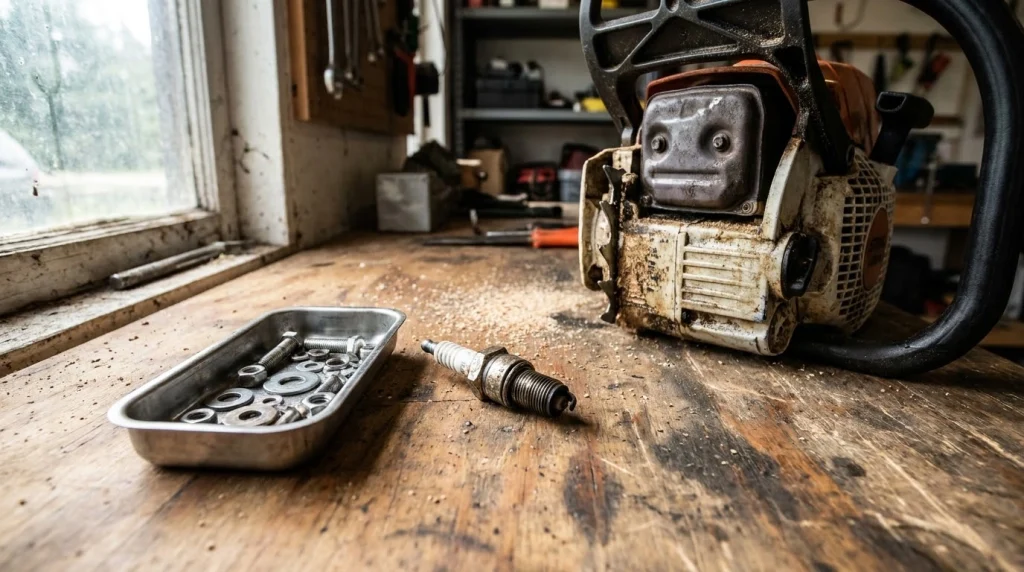
The fastest way to narrow down a chainsaw starting problem is to match its symptoms with the systems most likely to be affected.
The following table compares common symptoms, possible causes, and appropriate next checks.
| Symptom | Possible Cause | What to Check |
|---|---|---|
| Wet spark plug | Flooding or failed combustion | Choke, spark quality, and compression |
| Dry spark plug | Insufficient fuel delivery | Fuel filter, fuel lines, and carburetor |
| Unusually easy starter pull | Possible compression loss | Piston rings and decompression valve |
| Engine fires briefly | Incorrect mixture or fuel restriction | Starting controls and carburetor |
| Visible spark but no ignition | Weak spark or incorrect timing | Spark plug and ignition system |
| Power loss before starting failure | Restricted airflow or internal wear | Exhaust, air filter, and compression |
| Starting failure after storage | Degraded fuel or carburetor deposits | Fuel quality and fuel system |
These symptoms provide diagnostic clues, but they do not confirm a specific fault. Test the suspected system before replacing parts.
Check for Engine Flooding
A flooded chainsaw contains more fuel than the available air can support during combustion. The excessive fuel prevents the engine from firing normally.
Flooding can occur when you repeatedly pull the starter with the choke fully engaged. The problem becomes more likely when the engine has already attempted to fire.
Signs of a Flooded Chainsaw
A gasoline-soaked spark plug and a strong fuel odor are common indications of possible engine flooding.
Look for these symptoms:
- A wet spark plug after repeated starting attempts.
- A noticeable gasoline smell.
- No sustained ignition despite repeated starter pulls.
- Starting failure after excessive choke use.
- Brief firing followed by complete starting failure.
A wet plug alone does not confirm flooding. Weak ignition and insufficient compression can also leave unburned fuel inside the cylinder.
How to Address a Flooded Engine
A flooded chainsaw needs the excess fuel cleared according to the manufacturer’s approved starting procedure.
- Stop repeated starting attempts.
- Switch off the ignition and allow hot components to cool.
- Consult the owner’s manual for the flooded-engine starting procedure.
- Inspect the spark plug if the manufacturer recommends doing so.
- Return the choke and starting controls to the specified positions.
- Reassemble all removed components before attempting to start the engine.
The STIHL chainsaw FAQ explains how excessive use of the full choke setting can lead to flooding.
Warning
Gasoline vapors can ignite during spark testing. Keep ignition sources away from spilled fuel and follow the manufacturer’s approved testing procedure.
Verify That Fuel Reaches the Cylinder
Fuel inside the chainsaw tank does not prove that enough gasoline reaches the combustion chamber. Restrictions in the fuel system can prevent the engine from receiving a usable mixture.
Inspect Fuel Quality
Degraded or contaminated gasoline can interfere with combustion even when the tank contains plenty of fuel.
If the chainsaw has been stored with gasoline inside, replace questionable fuel with a fresh mixture that meets the manufacturer’s requirements.
Confirm that you have filled the fuel tank with the correct gasoline mixture rather than bar and chain oil.
Check the Fuel Filter
A blocked fuel filter restricts gasoline movement from the tank toward the carburetor.
Dirt and deposits can reduce fuel flow. Inspect the filter according to your owner’s manual and replace it if the manufacturer recommends replacement.
Inspect the Fuel Lines
Damaged fuel lines can interrupt fuel delivery or allow unwanted air to enter the fuel system.
Examine accessible fuel hoses for:
- Visible cracks.
- Brittle material.
- Loose connections.
- Kinks or restrictions.
- Signs of gasoline leakage.
Do not attempt to start a chainsaw with a leaking fuel system. Replace damaged components with parts specified for your model.
Check the Carburetor
A malfunctioning carburetor can prevent the engine from receiving the correct mixture of gasoline and air.
Deposits inside small fuel passages may restrict delivery. A damaged diaphragm, which is a flexible part that helps control fuel movement, may also cause starting problems.
Carburetor faults may produce either an excessively rich mixture or an excessively lean mixture. A rich mixture contains too much fuel, while a lean mixture contains too little fuel.
If external fuel checks reveal no problem, have the carburetor inspected before adjusting its settings.
Use Spark Plug Condition as a Diagnostic Clue
The condition of the spark plug can help distinguish insufficient fuel delivery from flooding or failed combustion.
If you
Find a gasoline-soaked spark plug.
Choose flooding and ignition checks, because fuel may be entering the cylinder without burning.
If you
Find a dry spark plug after starting attempts.
Choose fuel delivery checks, because gasoline may not be reaching the combustion chamber.
If you
Find heavy deposits on the spark plug.
Choose spark plug and mixture checks, because deposits may interfere with ignition.
Inspect the Air Filter and Choke
A restricted air intake can prevent a chainsaw from starting by reducing the oxygen available to ignite the fuel mixture.
Chainsaws operate around sawdust, wood particles, and dirt. These materials can collect inside the air filter and restrict airflow.
Check for a Dirty Air Filter
A heavily contaminated air filter can contribute to an overly rich mixture and difficult starting.
- Turn off the ignition and allow the engine to cool.
- Remove the air filter cover according to the owner’s manual.
- Inspect the filter for sawdust, oil, and damage.
- Clean or replace the filter using the approved method.
- Reinstall the filter and secure the cover.
Different filter materials require different cleaning methods. Follow the manufacturer’s instructions instead of applying an unsuitable solvent or cleaning technique.
Inspect the Choke Mechanism
A stuck or incorrectly positioned choke can prevent the engine from receiving the appropriate starting mixture.
The choke limits incoming air during cold starting. If the mechanism remains closed when additional airflow is needed, the engine may become flooded.
Confirm that the choke control moves normally and reaches the positions specified in your owner’s manual.
Check for Exhaust Blockage
A blocked exhaust system can interfere with combustion by preventing burned gases from leaving the cylinder efficiently.
Two-stroke engines depend on gas movement through their intake and exhaust systems. A severe restriction can reduce engine performance and contribute to starting failure.
Inspect the Spark Arrestor Screen
A clogged spark arrestor screen can restrict exhaust flow and cause running or starting difficulties.
The spark arrestor is a small screen designed to reduce the release of hot particles from the exhaust. Carbon deposits can accumulate on the screen during engine operation.
Follow the owner’s manual for inspection, cleaning, or replacement. Never permanently remove the spark arrestor to improve engine performance.
Check for Muffler Problems
A damaged or internally blocked muffler can interfere with exhaust movement even when the spark arrestor appears clean.
External inspection may reveal damaged parts or unusual deposits near the exhaust outlet. Internal blockages require additional inspection by a qualified technician.
Exhaust repairs should preserve the manufacturer’s original safety and emissions features.
Check Engine Compression
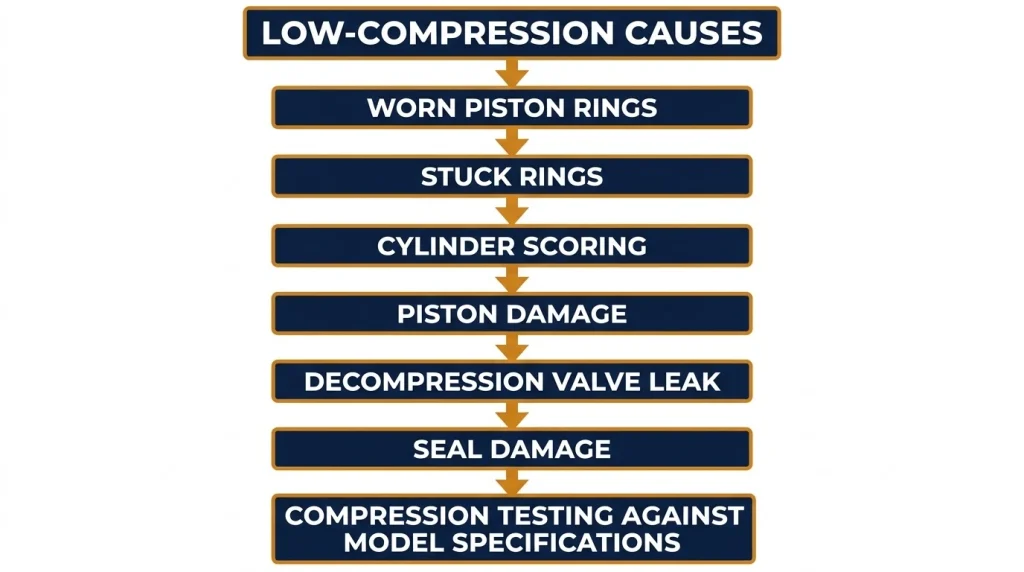
Low engine compression can prevent a chainsaw from starting even when fresh fuel and a functional ignition system are present.
Compression occurs when the piston moves upward and squeezes the air-fuel mixture inside the cylinder. Worn or damaged components can allow pressure to escape.
What Causes Low Chainsaw Compression?
Chainsaw compression loss can result from damaged piston rings, cylinder wear, piston damage, or leakage through a decompression valve.
Possible mechanical causes include:
- Worn piston rings.
- Stuck piston rings.
- Scoring or scratches on the cylinder wall.
- Damaged piston surfaces.
- A leaking decompression valve.
- Damaged cylinder sealing surfaces.
Manufacturer guidance on common chainsaw problems includes compression and piston condition among the diagnostic checks for an engine that refuses to start.
How to Identify Possible Compression Loss
An unusually easy starter pull can indicate reduced compression, although starter resistance alone cannot confirm the engine’s internal condition.
Some chainsaws have a decompression valve that intentionally reduces starting resistance. Other models use starting mechanisms that change how the starter cord feels.
A proper compression tester provides more useful information than judging the resistance of the pull cord.
How Much Compression Does a Chainsaw Need?
The compression required to start a chainsaw depends on its engine design, displacement, decompression system, and manufacturer specifications.
There is no single compression reading that reliably applies to every gas-powered chainsaw. Test results also depend on the equipment and testing procedure.
Compare the measured compression with the service specifications for your exact model. If the reading falls outside the approved range, further engine inspection may be necessary.
What if the Piston or Cylinder Is Damaged?
Internal piston or cylinder damage generally requires mechanical repair rather than fuel replacement or carburetor adjustment.
Replacing the spark plug will not restore compression lost through damaged piston rings. Repeated attempts to start a mechanically damaged engine may worsen the problem.
Ask a qualified technician to inspect the piston, cylinder, and related components before deciding whether the repair is worthwhile.
Verify Spark Quality, Not Just Spark Presence
A visible spark outside the cylinder does not guarantee that the ignition system can ignite the compressed fuel mixture inside the engine.
Ignition performance depends on the condition of the spark plug, ignition module, electrical connections, and operating environment.
Check the Spark Plug Condition
A worn, contaminated, or incorrectly specified spark plug can contribute to unreliable ignition.
Inspect the plug for these conditions:
- Heavy carbon deposits.
- Gasoline or oil contamination.
- Damaged electrodes.
- A cracked ceramic insulator.
- Incorrect electrode gap.
Use the spark plug type and electrode gap specified by the chainsaw manufacturer. Install a compatible replacement when the existing plug is damaged or excessively worn.
Can a Spark Plug Fire Outside the Cylinder but Fail Inside?
A spark plug may produce a visible spark in open air but fail to ignite a mixture under cylinder pressure.
As explained in this two-stroke engine troubleshooting guide, producing a spark under compression requires more ignition energy than producing one in open air.
A suitable ignition tester and manufacturer-approved testing procedure can help identify weak ignition performance.
Inspect the Ignition Coil and Connections
An ignition coil or related electrical connection can produce intermittent or insufficient spark rather than failing completely.
Check accessible ignition connections for visible damage or looseness while the engine is switched off.
If the correct replacement spark plug does not resolve the problem, have the ignition module tested according to the manufacturer’s service procedure.
Inspect the Ignition Timing
Incorrect ignition timing can prevent a chainsaw from starting because the spark occurs at the wrong point in the engine cycle.
A properly timed ignition system ignites the fuel mixture when the piston reaches the appropriate position. A strong spark cannot compensate for a serious timing error.
Check for Flywheel-Related Problems
A displaced flywheel or damaged flywheel key can alter ignition timing on chainsaw designs that use a keyed flywheel.
The flywheel key helps maintain the required alignment between the flywheel and crankshaft. Damage to this component can change their relative positions.
Flywheel inspection requires suitable tools and model-specific service information. Have a qualified technician perform this check if simpler diagnostic tests reveal no fault.
Check the Ignition Module Position
An incorrectly positioned ignition module may interfere with ignition performance on engines that require a specified clearance between the module and flywheel.
The required clearance varies by chainsaw model. Avoid using a universal setting that may not match your engine.
Ignition timing and module installation deserve particular attention if starting problems appeared after engine or ignition repairs.
Check for Crankcase Air Leaks
Crankcase air leaks can prevent a two-stroke chainsaw from maintaining the pressure conditions needed for proper fuel movement and combustion.
The crankcase is the enclosed area around the engine’s crankshaft. In a typical two-stroke chainsaw, pressure changes inside this area help move the fuel mixture through the engine.
Common Sources of Air Leaks
Unwanted air can enter through damaged seals, gaskets, or connections within the engine’s intake and crankcase systems.
Possible leak locations include:
- Crankshaft seals.
- Intake manifold connections.
- Cylinder base gasket.
- Carburetor mounting gasket.
- Crankcase sealing surfaces.
- Damaged impulse lines, where fitted.
An impulse line transfers pressure changes that help operate the carburetor’s fuel pump on some engine designs.
How to Confirm a Crankcase Leak
Pressure and vacuum testing can identify sealing problems that ordinary spark and compression checks may not detect.
A cylinder compression test measures a different aspect of engine sealing. Acceptable cylinder compression does not automatically rule out a crankcase leak.
Crankcase testing requires appropriate sealing equipment, test tools, and model-specific specifications. Professional testing is preferable to replacing seals based only on symptoms.
Review the Chainsaw Starting Procedure
An incorrect starting procedure can prevent an otherwise functional chainsaw from starting, particularly when the engine becomes flooded or receives an unsuitable fuel mixture.
Cold and warm engines may require different choke settings. Some models also use an air purge bulb, decompression valve, or electronic engine management system.
Before another starting attempt, confirm the following:
- The ignition control is in the specified operating position.
- The chain brake is engaged for starting.
- The choke position matches the engine temperature.
- The purge bulb is used as instructed, if fitted.
- The decompression control is used correctly, if fitted.
- The chainsaw is supported in an approved starting position.
Follow the instructions for your exact model instead of assuming that every gas chainsaw uses the same starting sequence.
Correct Troubleshooting Order
A systematic troubleshooting sequence helps identify the actual starting fault before you spend money on replacement parts.
Begin with external checks. Move to specialized mechanical and electrical testing only when basic inspection does not explain the failure.
Step 1
Verify Starting Controls and Fuel
Confirm that the ignition switch, choke, and fuel mixture match the manufacturer’s instructions.
Step 2
Inspect the Spark Plug
Look for wetness, deposits, damage, and an incorrect electrode gap.
Step 3
Check Fuel Delivery
Inspect accessible fuel hoses, the fuel filter, and signs of carburetor problems.
Step 4
Inspect Airflow and Exhaust
Check the air filter, choke mechanism, and spark arrestor for restrictions.
Step 5
Measure Engine Compression
Use an appropriate compression tester and compare the result with model-specific service specifications.
Step 6
Investigate Advanced Engine Faults
Arrange professional checks of ignition strength, flywheel timing, carburetor operation, and crankcase sealing.
This sequence separates common maintenance problems from faults that require specialized diagnostic equipment.
When Does a Chainsaw Need Professional Repair?
A chainsaw needs professional repair when starting problems involve internal engine damage, suspected fuel leaks, ignition timing faults, or unsuccessful basic troubleshooting.
Arrange a professional inspection if you notice any of the following:
- Compression below the manufacturer’s service specifications.
- Visible piston or cylinder damage.
- A suspected crankshaft seal leak.
- Repeated flooding despite correct starting procedures.
- Suspected flywheel or ignition timing damage.
- Fuel leakage from the tank, carburetor, or hoses.
- Persistent starting failure after completing basic checks.
A technician can test individual systems and determine whether the engine needs adjustment, component replacement, or more extensive repair.
Confirming the fault first reduces unnecessary replacement costs and avoids introducing new problems through incorrect adjustments.
As an Amazon Associate, we earn from qualifying purchases.
Small Engine Compression Tester
A compatible compression tester helps measure cylinder pressure when investigating possible mechanical causes of chainsaw starting failure.
Frequently Asked Questions
Can a new carburetor prevent a chainsaw from starting?
A newly installed carburetor can prevent a chainsaw from starting if the replacement part is incompatible or installed incorrectly. Incorrect gasket placement, disconnected hoses, and unsuitable settings may affect fuel delivery. Confirm the replacement part number and installation requirements before changing other engine components.
Can a decompression valve cause starting problems?
A leaking decompression valve can contribute to starting failure by allowing cylinder pressure to escape during the engine cycle. The valve normally reduces resistance during starting on equipped models. If the valve fails to seal correctly, a technician should inspect its condition and operation.
Can a blocked fuel tank vent stop a chainsaw?
A blocked fuel tank vent can interrupt fuel delivery by preventing the pressure inside the tank from balancing correctly. The engine may experience fuel starvation as gasoline leaves the tank. Have the vent inspected if starting or running problems repeatedly occur despite clean fuel lines.
Why won’t my chainsaw start after changing the spark plug?
A chainsaw may remain unable to start after spark plug replacement because another system is responsible for the original fault. An incompatible replacement plug can introduce additional ignition problems. Confirm the plug specification before investigating compression, airflow, fuel delivery, and other ignition components.
Should I use starting fluid on my chainsaw?
Starting fluid should not be used on a chainsaw unless the engine manufacturer specifically approves the product and its application. An unsuitable starting fluid may interfere with lubrication or create a fire hazard. Follow the approved fuel and diagnostic procedures instead of introducing unapproved substances.
Can a chainsaw stop starting after overheating?
Overheating can contribute to chainsaw starting failure if excessive engine temperatures damage internal components or affect ignition performance. Allow the engine to cool before inspection. If starting failure follows overheating and unusual power loss, arrange compression and ignition tests before returning the chainsaw to service.
Is repairing a chainsaw with low compression worthwhile?
Repairing a chainsaw with low compression depends on the damaged components, repair cost, and overall condition of the equipment. A service estimate can help you compare engine repair with replacement. Confirm the source of compression loss before deciding whether the chainsaw should be repaired or retired.
Conclusion
When a chainsaw has fuel and spark but won’t start, the remaining causes may involve flooding, restricted airflow, inadequate fuel delivery, compression loss, or ignition timing. Start with the spark plug and external fuel system checks, then arrange compression and advanced ignition testing if the engine still refuses to start.
I write about chainsaw maintenance, troubleshooting, replacement parts, safety, and buying guides. My goal is to make chainsaw information simple, practical, and helpful for homeowners and professionals.